
 16 Feb 2026

16 February 2026, Singapore – Singapore Changi Airport today announced that passenger traffic between Australia and Singapore in 2025 reached an all-time high of 6.7 million passenger movements, representing a 4.2% increase year-on-year from 2024. This was 6.4% more than the traffic registered pre-Covid, when 6.3 million passengers travelled between the two countries in 2019. Visitor arrivals from Australia to Singapore reached 1.3 million in 2025, an 18% increase compared to 2019.
Changi Airport continues to register sustained momentum in passenger traffic, marked by continued expansion of its global network. In 2025, Changi handled close to a total of 70 million passenger movements, reflecting sustained growth and firmly surpassing pre-Covid levels.
With an annual handling capacity of 90 million passengers, Changi remains the leading air hub in the Asia-Pacific region. More than 7,300 weekly flights served by some 100 airlines connect Changi to about170 cities worldwide, providing travellers with a wide variety of destination options. The airport's role as a key global connector was further strengthened in 2025 with the launch of 13 new city links, such as Harbin and Zhangjiajie in China, Labuan Bajo and Padang in Indonesia, Vienna (Austria), Ulaanbaatar (Mongolia) and Nha Trang (Vietnam).
Australia continues to be one of Changi Airport's key markets, ranking as its fourth-largest passenger market in 2025. This strong performance is a testament to the strong travel demand between Australia and Singapore, and Changi's role as a preferred gateway for Australian travellers to Asia and beyond.
Changi Airport as the most connected airport to Australia
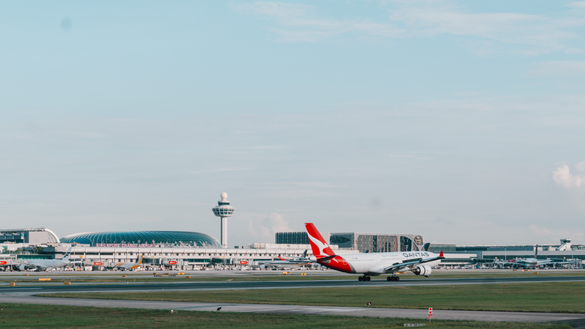
Changi Airport is currently the most connected international gateway to Australia by weekly flight frequencies, surpassing other regional hubs such as Auckland. Singapore is connected to Australia via six airlines that operate more than 250 weekly services. Current city links include Adelaide, Brisbane, Cairns, Darwin, Melbourne, Perth and Sydney. Upcoming connections to Newcastle and Sunshine Coast via Denpasar come March 2026 will bring the total number of Australian cities connected to Singapore to nine.
A broad mix of full-service and low-cost carriers supports this robust connectivity, namely Qantas, Jetstar Airways, Singapore Airlines, Scoot, British Airways and Turkish Airlines.
Beyond point-to-point travel, Changi plays a critical role as a transfer hub for Australian travellers. The top 10 onward transfer cities via Changi are London, Delhi, Phuket, Bangkok, Colombo, Kuala Lumpur, Tokyo, Ho Chi Minh City, Mumbai, Osaka*. The growth in travel demand between Australia and Singapore market is driven primarily by leisure travellers and those visiting friends and relatives, who together account for 90% of visitors.
*Listed in descending order of passenger traffic.
Changi as a gateway to Asia
Changi Airport's strength lies in its unparalleled connectivity across Asia, offering access to 49 cities across all 10 Southeast Asian countries via over 1,600 weekly services. Spanning Malaysia, Thailand, Indonesia, Vietnam, the Philippines, Cambodia, Myanmar, Brunei, Laos and Timor-Leste, this extensive network positions Singapore as the natural gateway for Australian travellers seeking options and seamless access to the region's most dynamic destinations.
Travellers consistently choose Changi for its operational efficiency and seamless transfer experience, complemented by its award-winning airport environment and service staff. From short connection times to a consistently high service standard, Changi continues to set the benchmark as a key air hub in Asia.
Building for the future
To support long-term growth, Changi Airport is making significant investments to cater to the strong growth in travel demand in the region. A new Terminal 5 which will have an initial capacity of around 50 million passenger movements per year is being built, with operations expected to commence in the mid-2030s. Changi Airport will also operate a three-runway system, enhancing Changi's ability to handle increased aircraft movements.
In parallel, to further enhance passengers' experience, Changi is upgrading its infrastructure to enhance the airport's capacity, efficiency and resilience. Terminal 3 (T3) will be upgraded, while the Terminal 1 arrival immigration halls will be expanded. The Skytrain subsystems will be rejuvenated, along with upgrades to the T3 baggage handling system, and the construction of a new inter-terminal baggage conveyance system linking Terminals 1 and 3.
On the airside, new airside facilities such as satellite gates are being constructed to enhance passengers' transit experience. At the same time, as more aircraft stands are added, Changi's taxiways will also be reinforced and existing aircraft stands upgraded to handle Boeing's new B779 family of planes.
These physical upgrades are complemented by broader innovation initiatives which are already in operation, such as passport-less immigration clearance across all four terminals, the use of artificial intelligence for predictive operations, and the deployment of driverless systems for baggage transfer. Together, these efforts ensure Changi remains competitive, resilient and ready for future demand.
Changi is not simply responding to growth, it's planning ahead of it.
Find out more about Changi Airport
Changi Airport looks forward to engaging with industry partners and stakeholders at IMM Australia 2026 to exchange perspectives, share insights, and explore opportunities for collaboration.
You can find more about Changi Airport's connectivity and amenities here.
Follow Changi Airport on social media: Facebook | X | Instagram | TikTok | LinkedIn | Telegram | YouTube
–––
For more information, please contact:
Vera Leng
+65 8511 8105 (Mobile)
vera.leng@changiairport.com
About Changi Airport Group
Changi Airport Group (Singapore) Pte Ltd (CAG) (www.changiairport.com) was formed on 16 June 2009 and the corporatisation of Singapore Changi Airport (IATA: SIN,ICAO: WSSS) followed on 1 July 2009. As the company managing Changi Airport, CAG undertakes key functions focusing on airport operations and management, air hub development, commercial activities and airport emergency services. It also manages the Changi East development project, which includes the building of a new Terminal 5 for Changi Airport. CAG also operates Seletar Airport (IATA: XSP, ICAO: WSSL) and through its subsidiary Changi Airports International, invests in and manages airports around the world.
One of Asia's most connected international aviation hubs, Changi Airport links Singapore directly to about 170 cities globally, with close to 100 airlines operating more than 7,300 flights weekly. Jewel Changi Airport, a multi-dimensional lifestyle destination, opened in April 2019, bringing Changi Airport's shopping and dining offering to over 700 F&B and retail outlets. Changi is the world's most awarded airport, having received over 700 accolades for its consistent and excellent airport staff service, passenger experience and safety standards.
